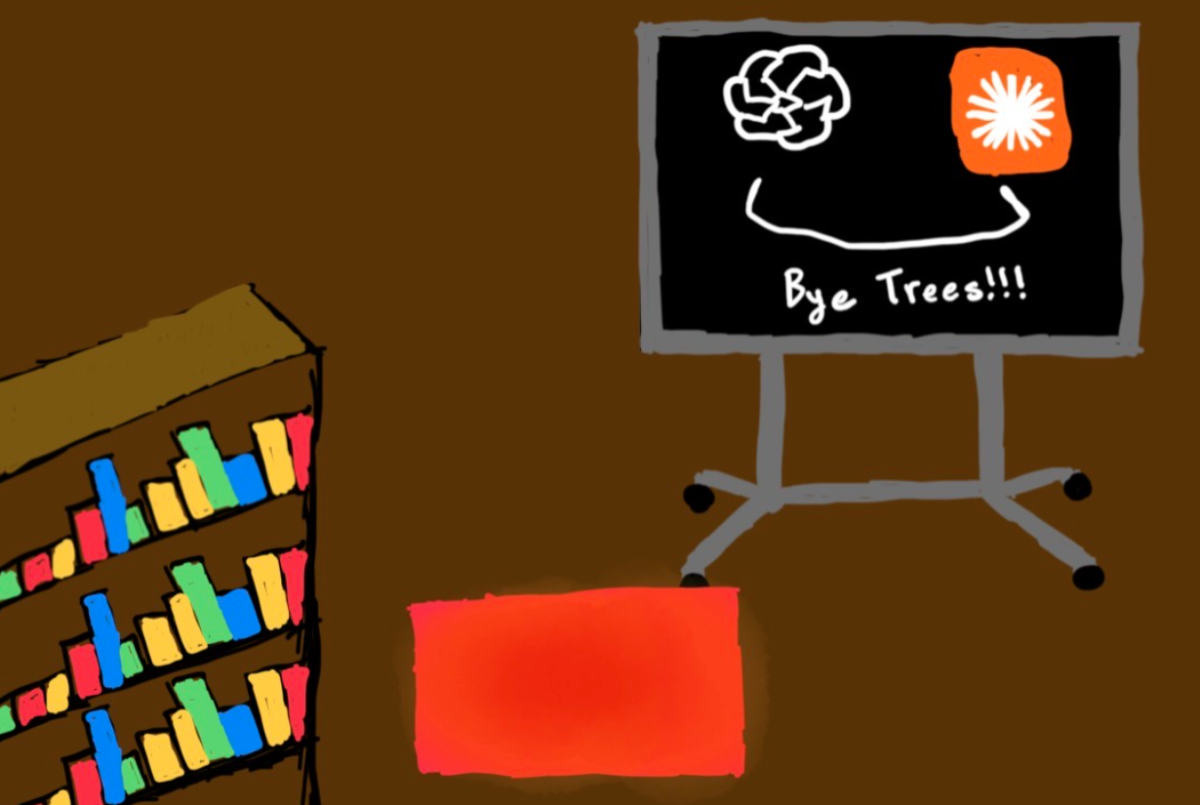
The library now contains a forest that has never existed.
It lives on the Viewboard. It grows at a steady, confident rate of one tree every three seconds. The trees are identical–not in a comforting way, but in a way that suggests the concept of “tree” was explained once and then mass-produced.
A river runs through it; it follows an equation of y = 5xsin(x). It splits into three, then four, then eight, then an ocean, and recombines. The water is clear, except where it becomes rock for a frame and then apologizes. This is the video. It does not loop. That would imply memory. It simply continues to generate, like Sisyphus rolling his boulder up the hill, but now the boulder has three legs, and he has four fingers.
Students sit beneath it, opening assignments on Schoology, occasionally glancing up as the sky replaces itself. A new form of art, called Vibe-Foresting, has emerged, and it creates landscapes with questionable results. The sun appears, its rays contorting like tentacles, behaving like its computer world is flat, and leaves. A second sun arrives shortly after, slightly off-center and more ambitious, each after another testing the boundaries of real and unreal.
No one reacts.
The administration has described this as “calming nature footage,” which is interesting because nature appears to be under pressure. Mountains rise too quickly, as if they are aware they are behind schedule. Clouds form grids, and a deer assembles itself incorrectly and stands there, thinking about it. This is true wellness.
Not the absence of stress, but the presence of something so fundamentally confusing that stress becomes impractical. You can’t worry about your workload when a lake has just been rendered vertically. You can’t panic about grades when the horizon bends in a way that feels personal.
It is, in its own way, effective.
Because after enough time, as another identical tree confidently becomes a different identical tree, a realization settles in:
It’s almost ironic, as the real lakes and rivers are drained, we get an online copy. As each and every square inch of nature feeds the machine, the machine makes new, off brand, nature. It can be likened to an ouroboros, a snake eating its own tail in perpetuity, but instead of moving in a circle it moves in a line, perpetually consuming for the sake of consuming and showing its own excrement as proof that it adds value. Out of the beautiful works it consumes, it produces a homogenous, digested, and sterile product. Oh, that sounds like a great deal.