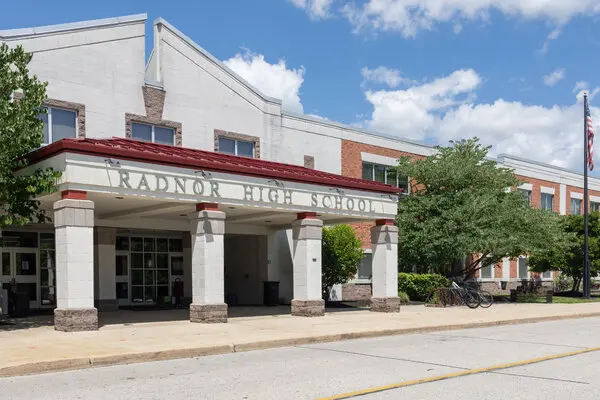
The American Academy of Child & Adolescent Psychiatry states that children spend a combined roughly 7 ½ hours of their day on a screen. Let’s say 2 of these hours are spent on a device outside of school. This could mean anything from watching a show in bed at night, or scrolling for 30 minutes in the morning at the kitchen counter while eating breakfast. That leaves about 5 hours of screen time during instructional school periods. At a glance, this might seem like a large number. In actuality, this isn’t hard to fathom, as most schoolwork is now assigned online. Radnor’s curriculum consists of things like watching educational movies, reading articles, taking online assessments, and as an even greater example, yours truly currently using screen time to write this very article.
Having the optimal technology is imperative in our modern day and age. To manufacture greatness, the young minds of students need to be taught correctly and efficiently. Hence, a shift in the technology used at Radnor isn’t something to be disregarded.
Students are already advocating and showcasing their own personal preferences in equipment without even realizing it firsthand. BYOD, or ‘Bring Your Own Device’ is a policy alternative to the Surface Go 1:1 program, and it enables students to bring a device of their own for learning. Usually, this device is a laptop or an Apple iPad. Bringing a device over using a Surface Go has slowly become more favored by students, due to the convenience of having full control over one’s device, and having personal applications readily available while doing schoolwork.
If I asked, “besides a Surface Go, what would you think students would use alternatively?,” one might answer along the lines of MacBooks and laptop brands like HP or Dell, but actually, the most popular seems to be the generation 11/ iPad Pro from Apple.
On Tuesday, March 24, Radnor High School sent out a survey to students during an extended homeroom period regarding usage of school issued devices versus usage of self-owned devices. The survey was pushed out to gain students’ input on Radnor’s future in technology. Now, early stages of ideas regarding a restyle from the Microsoft Surface-Go computers are circling throughout the township.
Why am I saying this?
Microsoft as a whole is shifting away from their SurfaceGo 4, the exact device Radnor Township uses for its 1:1 Surface Go policy. Additionally, the rise of AI tools and a recent trend in larger and more technical devices will surely influence an interesting shift in the policy.
In a brief interview with assistant principal of Radnor High School Mr. Presley, I asked him for his thoughts on the upcoming technology shift in the 2026-2027 school year, along with his thoughts regarding student technology usage. Mr. Presley explains that many students do in fact like the current SurfaceGo’s due to the accessible stylus pen feature, and the familiarity of using school-issued devices which Radnor has provided since 2019. Having students so used to using a certain device “increases class participation,” as engagement with the curriculum is always the main standard.
In regards to the tech department, Mr. Presley made a stalwart point quoting, “if there was ever a problem, students can always approach tech to receive help with their SurfaceGo.”
The way in which the curriculum is built around SurfaceGos creates a tough ‘road block’ when implementing devices like iPads, as the implementation of foreign devices can make service and repair more of a challenge.
Lastly, the Assistant Principal was asked, “what are your thoughts on the popularity of the Apple iPad being used among students participating in the BYOD practice?” He responded,“I think with this generation of students, accessibility works hand in hand, having something similar to the SurfaceGo, is the best resource for the students.”
Mr. Presley also noted that alongside device accessibility in the BYOD practice, “making sure that we have things in place so that students do not get distracted with applications” is crucial to optimize learning environments.
Several school districts are/have been all Apple-based when it comes to integrated technology.
Ultimately, the looming technological shift is a great idea, not only for the students, but for the school as well. The overall theme of renewing devices in the past couple of years, (with the new Viewboards in classrooms) has been making learning environments easier. One variable that definitely should be taken into account is the price of the technology, as many families may require financial assistance if the new devices introduced cost more than the current Surface Go computers. It will be interesting to see how the trend in foreign device usage potentially changes as new technology is implemented into Radnors classrooms.