One year after President Trump crushed democrats’ hearts with his stunning victory over then-Vice President Kamala Harris, that same party with those same crushed hearts came back stronger, sweeping the (lack of) major elections and proving that it was ready to assert its power. Though it is hard to tell much from an off year election with very few battleground races, let’s examine some of the major storylines from the day’s results.
Even Trump’s Endorsement Not Enough in NYC
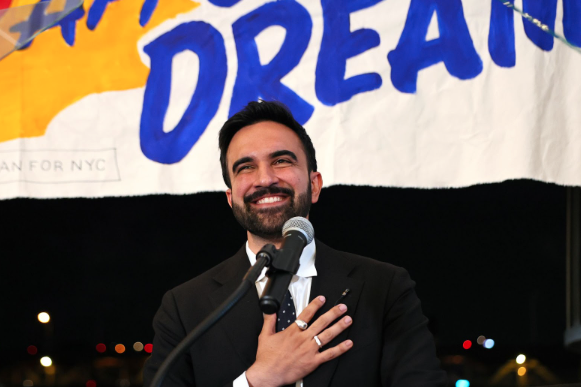
After Democratic Socialist Zohran Mamdani’s surprise primary win in June, his win in the New York City mayor’s race seemed all but certain. Mamdani’s path to victory in the primary was rather easy thanks to a scandal-ridden frontrunner in former mayor Andrew Cuomo, but his sudden rise to fame was impressive nonetheless. His main challenger in the general election, as it turns out, was the same as that of the primary.
The election started as a 4-horse race between Mamdani, Cuomo, current Mayor Eric Adams, and republican candidate Curtis Sliwa, who lost to Adams in 2021. Adams dropped out in late September, endorsing Cuomo. Many speculated that the drop out stemmed from a deal with President Trump, who had refused to make a specific endorsement before that. On November 3rd, Trump formally endorsed Cuomo, stressing the importance of defending the city from Mamdani, who he viewed as “an existential threat”.
The endorsement, however, was not enough to bring Cuomo over the edge, as Sliwa stayed in the race despite countless attempts from Trump and the RNC to get him to drop out. The race was called soon after polls closed, as expected, with Mamdani receiving over 50% of the votes to Cuomo’s 41% and Sliwa’s 8%. The results, despite Mamdani’s win, show a divided Democratic party, as many of the older leaders in congress – specifically Senate minority leader Chuck Schumer of New York – did not make a formal endorsement. NY Governor Kathy Hochul only endorsed Mamdani after immense pressure from the progressive wing of the party, and even despite her campaigning with him, it seemed ingenuine.
A divided democratic party needs to unite if they want to push back further against the Trump administration in the midterms. The schism that has arisen between older representatives and younger ones is not sustainable if the party is looking for long term success.
Moderates Emerge Victorious in Lean-D States
Virginia and New Jersey, two states that narrowly and expectedly swung to Harris in 2024, had closely watched Governor races. In New Jersey specifically, each party poured plenty of money into its respective candidate’s campaign. Mikie Sherill, the democratic candidate, held a fairly large lead in the polls before watching that lead dwindle in the weeks leading up to election day. Her opponent, Jack Ciattarelli, who lost the 2021 election to incumbent Phil Murphy, tied himself closely to President Trump. After a harsh anti-Trump campaign, Sherrill won the race in a surprise double digit victory that was heavily propped up by North Jersey’s democratic strongholds. The race proved, once again, that close ties to the president is not the way to go in a historically blue state.
Virginia was a more expected democratic victory, where former intelligence officer Abigail Spanberger beat out conservative Winsome Earl-Sears. Earl-Sears also attempted to closely align herself with the president, though Trump never gave her a formal endorsement. Many viewed her as a flawed candidate due to her lack of focus on major republican issues like the economy, and due to her extremely polarizing nature among the party’s higher ups, but she won the primary unopposed after two far-right challengers failed to get the required signatures to land on the ballot. Spanberger applied a similar approach to Sherill, attacking Sears for her ties to Trump, garnering mass support from the state’s democratic party that ultimately resulted in a 15 point victory.
Two moderate democrats were able to obtain victories in somewhat competitive states, albeit with flawed opponents. For the republican party, it furthers an already well developed and supported argument: if a candidate that is closely tied to Trump wants to win in a battleground state, they will likely need Trump on the ballot to do so. Republican candidates, specifically those from the MAGA sector of the party, have struggled in off year elections without the president getting voters to the polls. For democrats, these victories complicate things just a bit. The DNC leaders have appeared somewhat unwilling to endorse liberal candidates in past years, but a Mamdani victory paired with struggles from Spanberger and Sherrill likely would have opened the door for the AOC/Bernie Sanders wing to get their candidates an inroad. Conversely, a Mamdani loss paired with Spanberger and Sherill wins would have set the liberal wing back even further. All 3 winning, while obviously good for the party as a whole, could lead to more infighting when choosing candidates to endorse for midterms and beyond.
Judges Retained in PA, Prop 50 Passes in CA
While not necessarily elections, the democrats also emerged victorious in two crucial ballot measures in Pennsylvania and California. In Pennsylvania, a state that Trump and Senator Dave McCormick flipped in 2024, there were three judges up for a retention vote. By Pennsylvania law, every judge of its Supreme Court must go up for a retention vote ten years after their initial appointment. The Democratic Party retained its majority in the state’s Superior Court, with every judge receiving over 60% of the vote. While it is rare for a judge to not be retained, each party recognized the importance of this vote, especially in today’s political climate. With all the money poured into the race , it was surprising to see it not be close at all, though it was a somewhat expected victory. This win definitely signals a blue shift in Pennsylvania, though not as much as the numbers suggest, as it takes a lot of effort to not retain a judge.
In California, governor Gavin Newsom put himself even more on national watch with the passing of Proposition 50. This proposition allowed California to redraw congressional maps in an attempt to counter similar efforts from the GOP in Texas and other republican strongholds. The move will add 5 more safe democratic districts in the house for the midterms next year, as they look to flip at least one part of congress and face a tough senate map. Newsom, who appears to be gearing up for a 2028 presidential bid in which he will likely open as the democratic frontrunner, consistently made national news in his attempts to pass prop 50 and has emerged as the main opposition to Trump within his party.