In July, President Donald Trump issued an executive order that will impact teenagers in gym class across the country: the return of the Presidential Fitness Test. During the Cold War, research indicated that American children were substantially less fit than their European peers. To government officials, there appeared to be one solution to this problem— to require students to compete in demanding physical activities and offer recognition only to those who scored in the highest percentiles.
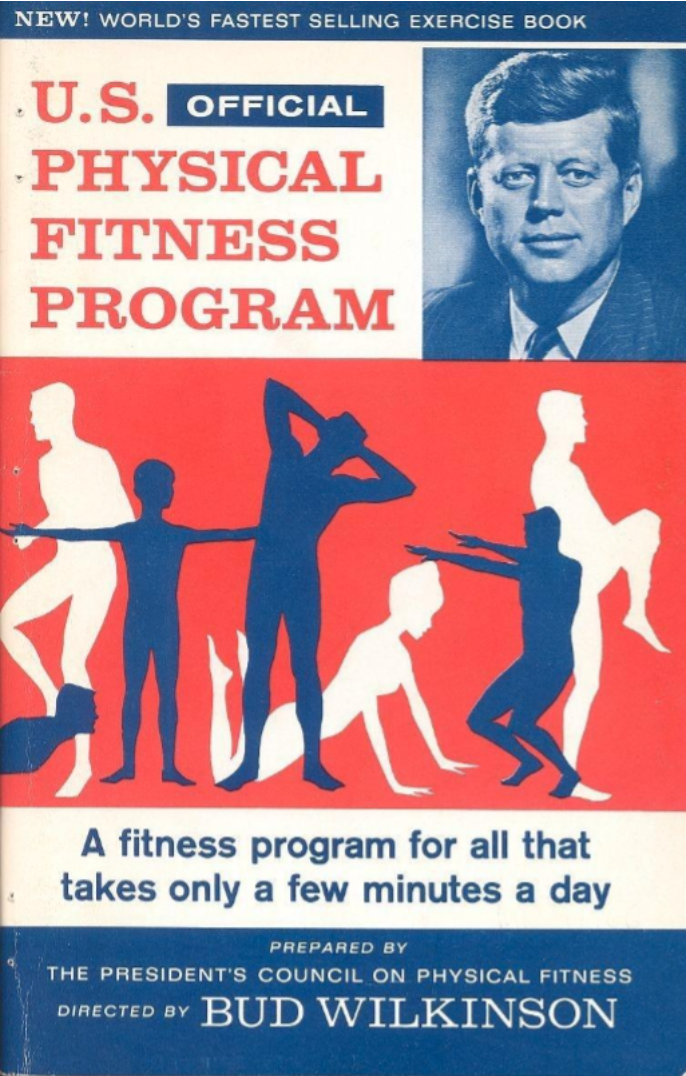
First created in the 1960s by President John F. Kennedy, the Presidential Fitness Test assessed students aged six to seventeen in five different areas of physical activity: a one-mile run, sit-and-reach, a shuttle run, sit-ups, and either push-ups or pull-ups. Children were then ranked against others in their age and sex categories. Those who scored in the 85th percentile or higher received an award dubbed the Presidential Fitness Award.
Some people, including myself, might think, “Only the 85th percentile? I could easily do that.” However, the assumption is misguided. The standards were brutal and unforgiving:only a trained athlete could realistically meet all benchmarks.
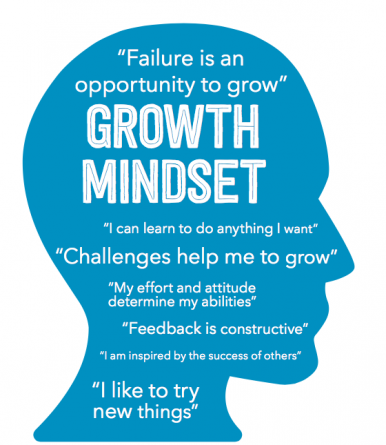
In the 2012–2013 school year, however, the test was replaced with less intense and more modern forms of fitness assessment, such as the pacer test. The Obama Administration introduced the Presidential Youth Fitness Program (PYFP) as the new approach to school fitness.. Under this program, the emphasis on fitness shifted from a competitive focus to a focus on encouraging personal health and setting a habit for lifelong fitness. Obama ended the pass/fail system, and encouraged schools to help students to set their own goals. For example, part of the PYFP was to run either the pacer test or the one mile. Under the old program, these runs would be timed and students would either pass and fail on whether they successfully made the designated age group time. Under the PYFP, students would set their own goal, and when repeating the test, measured improvement against their previous performance. This system allowed students to take charge of their own health, which created an environment of encouragement, rather than one of shame.
In the Presidential Fitness Test, one could very well argue how shameful the environment created was. For example, an environment in which some students earn awards while others do not can easily create a toxic sense of competition among young children. While students are constantly competing in school, the competition of fitness levels, one that compares one person’s body to another, will ruin the culture that schools so desperately try to create. This assessment was a test, and that was all it was. There was no meaningful feedback, which limited students’ ability to improve.
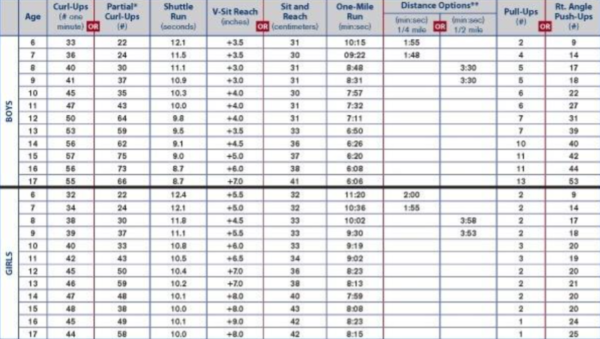
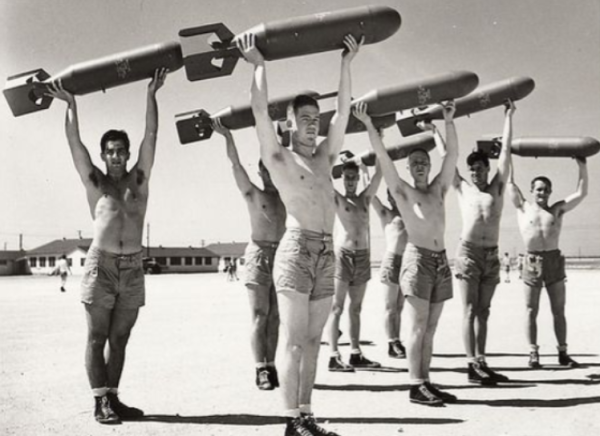
The chart above shows the standards for each age group for girls and boys. An average seventeen-year-old boy, for example, is expected to run a 6:06 mile and complete 13 pull-ups, among other tasks. To put that into perspective, an average adult man who is not an athlete would likely run a mile in 10 to 12 minutes. During the post World War II time period, the desired image of men was incredibly toxic, meaning that all men were supposed to appear as superb athletes. Men were further expected to show a level of bravery and courage that was reflected by their actions, clothes, and body shape. In some ways, this is understandable, as while in the midst of a war, a soldier has to be fit, disciplined, and courageous. For example, during the cold war, the soldiers were expected to be deployed at any moment, as threats were constantly issued by the USSR. At one point, when the stereotypes became incredibly intense, even movies were being released with the propaganda of a man’s expected body type. For example, in Rocky IV, the boxer, Rocky Balboa, is set to take on a soviet boxer by the name of Ivan Drago. Throughout the scenes, the Cold War body was exemplified by comparing Rocky’s rugged ‘American’ physique while running through snow and chopping wood, to Ivan’s super muscular, steroid ridden, robotic body. When Rocky prevails, symbolically, so does the U.S. However, today, the need for that kind of rugged body rapidly dwindles, as wars are fought much differently today, as compared to more than half a century ago. Now, the strength of manpower is simply used to operate machines with the power to destroy cities, therefore, not requiring the most rugged man possible.
Furthermore, students can find other ways to exercise at school. One way is to take part in school sports. School sports have been a tradition at high schools nationwide, and depending on how historically good a school is at a certain sport, the competition can get cutthroat. In fact, several award winning shows and movies have been produced revolving around high school football in Texas, including Friday Night Lights and Varsity Blues. Perhaps if we could find a way to make school sports more inclusive for all, and make students more motivated to join, students could achieve adequate exercise while also having fun.
More than 70% of children fail to achieve enough physical activity on a day-to-day basis, which is expected to play a significant cause in the U.S. obesity epidemic. For years, the stereotype that Americans were fat and lazy has been a hot topic. The reason this stereotype first came to life was due to the obesity epidemic. In the U.S., the percentage of children with obesity continues to rise at a concerning pace. On average, 1 in 5 children in America are obese. However, in low income families, 1 in 4 children aged six to seventeen face this same condition. Perhaps less affluent children struggle to find adequate exercise compared to their wealthier peers. Or perhaps, there is another underlying issue altogether. The reason Trump is bringing back the fitness test is to attempt and combat said epidemic. He believes that if we make our youth stronger, perhaps the country could be stronger, saying “We are building a nation of strong, proud, and unstoppable young Americans. The Presidential Fitness Test is not just about physical strength—it’s about character, competition, and confidence.” President Trump is attempting to rewrite the stereotypes about Americans by producing strong and disciplined youth. Sounds rather familiar to the super soldiers created in Captain America if you ask me. In my opinion, instead of focusing on the ability to “secure America’s greatness for generations to come” maybe we should focus on diplomacy with other countries, instead of wishing to instill fear.
However, many overlook the fact that lack of exercise plays only a small role in this complex issue. Children living in households below the poverty line are twice as likely to be obese compared to their more affluent peers. Healthy food is becoming increasingly expensive, forcing lower-income families to rely on cheaper, calorie-dense junk food. When nutritious foods are inaccessible or unaffordable, the likelihood of obesity rises. While both nutrition and exercise play key roles in preventing obesity, poor nutrition is generally a stronger indicator of why someone becomes obese than their level of physical activity. This prompts the question: could/should the government address the lack of nutritious foods through schools?
If government officials truly want to combat the obesity epidemic, they should focus less on instilling these high fitness standards and more on making healthy food accessible for all. Lowering the prices of fresh produce and improving food availability in low-income communities would be far more effective than reinstating an outdated fitness test. However, to be frank, congress has passed several bills to attempt to lower produce costs. One example includes the 66 billion dollars that have been added to farm programs nationwide via the one beautiful bill passed by President Trump. Before praise is showered upon Trump, let me state that this number is entirely deceiving. The bill was looking to strengthen the financial aspects of farms, not the actual nutritional part of farms itself. This means that the farmers will gain back up insurance on their crops in case of a disaster, as well as the profitability of farms due to new tax payment plans, meaning that the health benefits of farms will stay the same. Furthermore, this bill also canceled the SNAP-ed program, which funded healthy foods for less affluent families. This means that even though investments have been made to agriculture, the benefits are very likely not going to reach poverty-stricken areas.
On the other hand, comparing the agriculture investments this year, which was run by Trump’s administration to last, run by the Biden-Harris administration, the two differ greatly. The Biden-Harris administration put great investments into agriculture by October of 2024, and as a result, produce prices were significantly lowered. In July of 2023, when Biden’s agricultural agenda was first announced, the Secretary of the USDA (U.S Department of Agriculture), Tom Vilsack, stated that “[Biden’s] steps will allow families and farmers alike to benefit from healthier food produced closer to home” (USDA). Perhaps Trump should take a page out of Biden’s book and focus on the nutritional aspect of fitness, rather than the intense exercise part. No one can deny that the obesity epidemic is serious, but solving it requires tackling its core causes, such as equitable access to nutritious foods, rather than placing the burden on children’s performance in gym class.