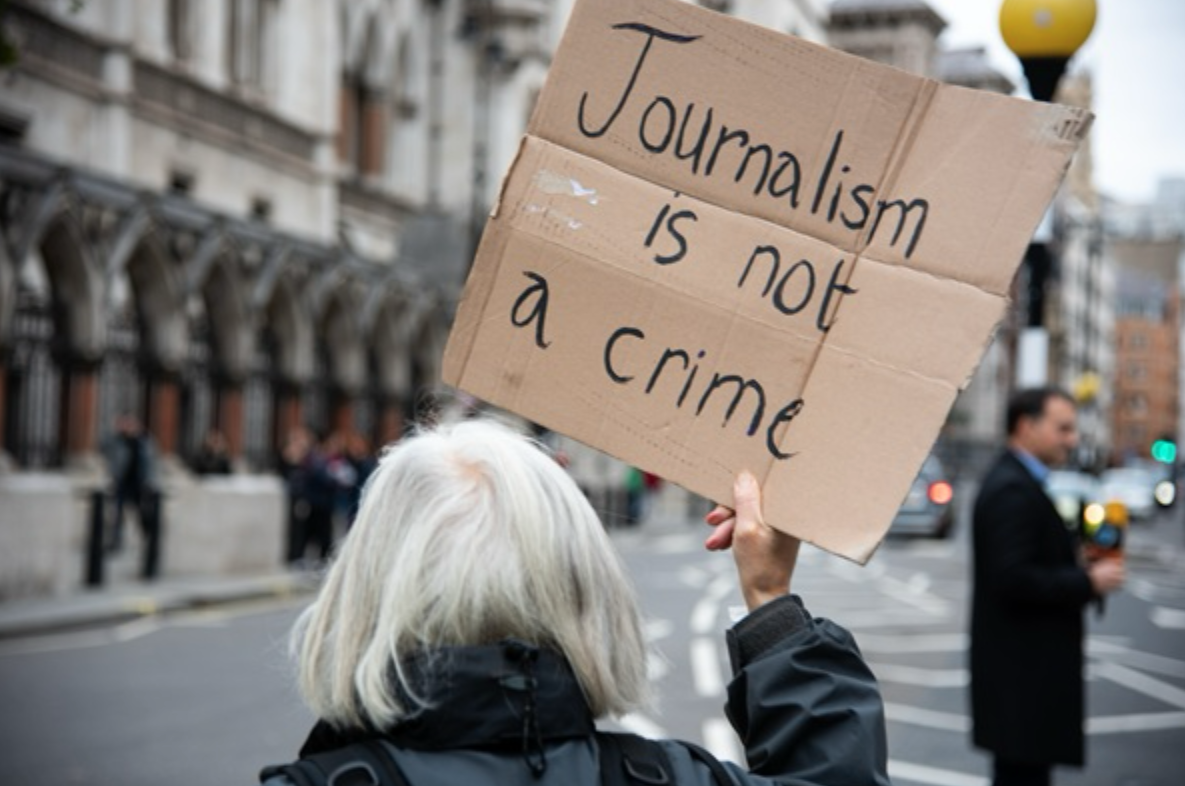
The First Amendment of the U.S. Constitution, arguably first not only in numbering, but in importance as well, guarantees every person in the nation the right to share their opinions. Since its establishment, movements such as the Civil and Suffrage Movements have wielded this liberty as a weapon in fights for respect, power, and further expansion of the Constitution. We cannot afford to take the freedoms provided by the First Amendment for granted, nor can we allow our government to hinder them.
This past summer, I interned with the Radnor League of Women Voters, dedicating three months of research to suffragettes who fought with journalism, creating magazines and newspapers dedicated to hearing the voices of women. I quickly realized how important the press was in the fight for equality and fair treatment. While the constitutional right to vote took a long time to expand beyond white men, the freedom of the press has widely been available to all adults following the passage of new amendments such as the Fifteenth and Nineteenth. Still, that does not mean it has existed without resistance, especially from our government.
In 1798, with the beginning of the Quasi-War with France, John Adams’ administration passed the Sedition Act, allowing the punishment of journalists who denounced actions of the government. For reference, this was five years after the ratification and complete Bill of Rights. During the Act’s three-year lifespan, more than fifteen journalists were fined or arrested. Even Benjamin Franklin’s grandson, Benjamin Franklin Bache, was jailed, where he passed away awaiting trial. While this criminalizing act only punished a select few, many newspapers published milder politics, and the democrat-republican party was silenced due to differing opinions described by federalists as “misinformation.”
Even though the Sedition Act expired over two centuries ago, debate over press freedom persisted. In 1917, the Espionage Act was passed by Congress, followed a year later by a new Sedition Act. These acts criminalized free speech and opinion when the U.S. was at war in an attempt to protect national security during World War I, also including provisions protecting military operations from outside interference created by false statements. Both were repealed within five years, but national security remained a concern with extensive media coverage of politics. For example, in New York Times Co. v. United States (1971) and United States vs. Washington Post Co., both newspapers had accessed classified information regarding the United States’ involvement in the Vietnam War. The Nixon Administration claimed that this information, called “The Pentagon Papers,” would harm national security if published. The court ruled in favor of the press, stating that it would be a violation of the First Amendment to prohibit the papers’ publication. Though, the Supreme Court did not consistently support a complete freedom of the press. In cases as early as United States v. Hudson & Goodwin (1812) and New York Times Co. v. Sullivan (1964) one-hundred-fifty years later, the Supreme Court determined the ability of the government to prosecute libel, or the defamation of a person/company by publishing a false statement.
During the rise of social media and COVID-19, our country grew more polarized about issues regarding misinformation. According to a survey by Pew Research Center, 38% of democrats and 47% of Republicans were heavily concerned about potential restrictions on press freedoms in April of 2024. By March of 2025, following the inauguration of President Donald Trump, 60% of Democrats reported heavy concern compared to only 28% of Republicans. This shift stems from President Trump’s immediate concern about the freedom of the press, expressed in Executive Order 14149 “Restoring Freedom of Speech and Ending Federal Censorship.” Here, former President Joe Biden’s administration is accused of hindering freedom of speech by, “combatting ‘misinformation,’ ‘disinformation,’ and ‘malinformation,’” which do not belong in a free society. President Trump perceived the actions of the administration before his to be limiting due to their suspected bias to left-wing media, and the pressure they placed upon social media companies to remove misinformation regarding COVID-19.
While the executive order reverses a hindering to the freedom of speech, President Trump’s administration has not consistently supported the ideals it claims to represent. It was announced in February of 2025 that current, partisan staff in the White House would choose which reporters could attend certain events. This breaks a multiple decade long tradition of the independent White House Correspondent’s Association (WHCA) deciding press attendance, now creating conditions for unequal coverage of political events as detailed by left and right wing media.
Altogether, press freedom isn’t guaranteed for everyone. From the exclusion of specific journalists to potential defamation and national security threats, limits to the media remain. No matter their beliefs, anyone in the public eye can struggle when journalists release news that offers a negative perspective of their actions, leading to the creation of aforementioned limitations. Additionally, the fear of misinformation now looms larger than ever, especially with social media, where people of all demographics see misinformation each day. News about celebrities, viruses, politics, and the entire world is shared every day, and not all of it is factual. However, it is unfair for our government to assume that all Americans are incapable of discerning truth from falsehood.
In recent years, I have learned to prioritize understanding all sides of a topic I see on the internet before I take a stance. Social media has become a part of our world, opening doors for free speech as well as misinformation. To have the former, we cannot evade the latter. If we continue to teach critical thinking skills and its application to the media in schools, we do not need to arm a full-fledged attack on misinformation. Education involves deciphering opinion and fact, learning where they come together, and how they are different. Eventually, we all have to make a choice: make our own educated decisions about what is right and what is wrong, or denounce our freedom.