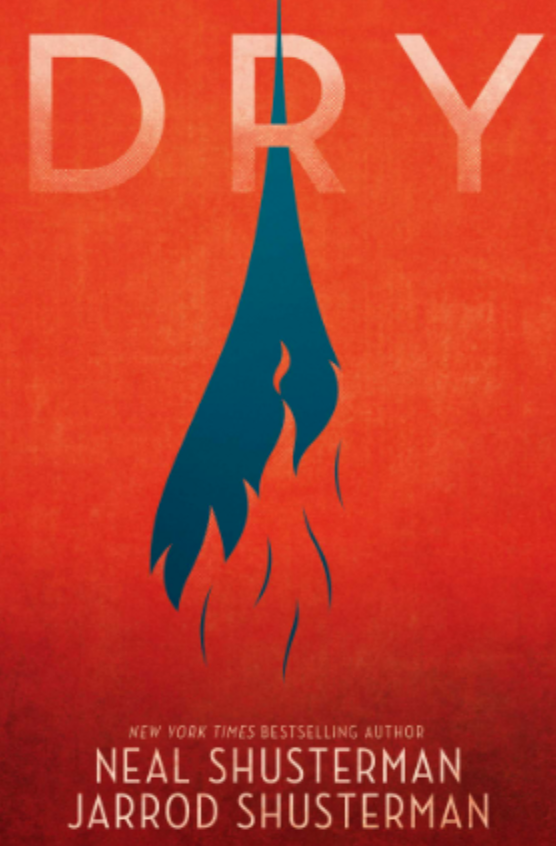
When I first skimmed through the 9th Grade summer reading list, one book stood out as the ideal cure for my boring days. Dry, by Neal and Jarrod Shusterman is a Young Adult novel about the societal consequences of eliminating water supply. Even though it promises tension and excitement, Dry ultimately became the reason my waking hours felt endless. What I assumed would be an enjoyable, fast-paced read turned into a relentless chore that occupied my time without providing the rigorous adventure I had hoped for. By the end, I was left wondering why this book is held in such high regard.
Published in 2018, Dry has been included in the American Library Association’s (ALA) Best Books for Young Adults and in the New York Library’s Best Books for Teens. It also has around 54,000 responses on a book review site called Goodreads, where its average rating is 4.01/5 stars. While the reading community seems to agree that this book is worthwhile, I find myself taking a contrary viewpoint.
Warning: Spoilers Ahead
In Dry, Neal and Jarrod Shusterman bring readers to a frightening dystopia where Southern California’s taps run dry, triggering a crisis known as the Tap-Out. Without their parents, Alyssa, sixteen, and her younger brother Garrett, ten, are left to search for water on their own. They turn to their survivalist neighbor, Kelton, to acquire skills and resources. The trio sets out to reach Kelton’s hidden shelter, the Bug-Out, encountering a bold delinquent and cunning opportunist along the way. The group’s primary focus ultimately shifts to survival as they watch society collapse around them.
Plot
While glancing through many of the lower ratings of Dry, I found that several reviewers shared my main criticism of the book’s plot: everything feels overly convenient. Our protagonist, Alyssa, is facing a life-threatening challenge where she lacks vital resources to survive. Thank goodness that her next-door neighbor Kelton is a survivalist that is willing to sacrifice anything for her, driven by a long-standing romantic interest! Later, the group is struggling to separate themselves from the desperate and dangerous society surrounding them. As luck would have it, they met a companion equipped with a reliable vehicle. And as a fire nearly engulfs the group, an inexplicably timed helicopter suddenly rescues them and brings them back to safety. I understand that storytelling requires both conflict and resolution, but it becomes difficult to suspend disbelief when every major issue is resolved in a predictable way.. Ultimately, the story lacked the necessary jolts to keep me engaged.
A more unique perspective I had on Dry had to do with both the pacing and structure of the book. Dry was painfully slow at times. Entire chapters would be spent on periods of resting or traveling. These moments added no real development to the characters or the story. It almost felt like the Shustermans forgot that, when writing a book, the same number of pages do not need to be dedicated to every interval of time. Important climactic moments are rushed while dull, anticlimactic moments would drag on for ages. This problem made certain parts of the book arduous to get through.
Furthermore, the structure of Dry also had several issues. The characters throughout the entire story would embark on journeys that, due to their lack of focus towards the central plot, were ‘side quests’. These events often occupied several pages, but after completion, the main conflict would be unaltered. The characters were no closer to survival as they were entire chapters ago. Dry would have benefited from a more centralized story with fewer sub-plots.
Characters
To be honest, my favorite part of reading books is learning about the characters and how their different archetypes respond to the plot of the story. I enjoy getting to know people; fictional or not. One aspect of Dry that I did find relieving was the character building that the Shustermans’ conducted. By the end of the story, I had learned enough about the three protagonists to sympathize with them. Regardless, Alyssa, Kelton, and Jaqui still did not satisfy my enjoyment of people. After turning the last page of the book, I sat wondering what felt so off about these characters that I knew so well. Through much deliberation, I realized that my problem stemmed from how insincere each person’s actions and reactions felt. I found that the Shusterman’s character development, while extensive, did not fit closely enough to how real teenagers typically think and behave. As a result, the characters were inauthentic. To provide a bit more context:
Alyssa (Courageous, resourceful, compassionate): Out of the protagonists, Alyssa was easily my favorite. She was the most competent of the group; making many rational decisions that moved the plot along. Unlike the others, her personality traits felt balanced, with the right amount of vulnerability and confidence. I could actually relate to her motivations. If the Shusterman’s had written all the characters with the same realism as Alyssa, so many of my issues with the plot could have been fixed and the story would feel more genuine.
Kelton (Nerdy, awkward, intelligent): Kelton was, for sure, my least favorite of the protagonists. Barring his severe annoyingness, his actions left me angered by how idiotic they were. As a character who is supposed to be the smart one of the group, you would expect most of his decisions to be rational. Instead, he was the principal reason for the group’s downfall. His nerdiness and awkwardness were so overamplified that I pictured him more as a cartoon character than a person. It was difficult to relate to his thought process because he felt so unrealistic.
Jaqui (Bold, pragmatic, independent): Jaqui could be described as your typical ‘not like the other girls’ character. She takes action in an emotionless way that some might consider psychotic. I find her position in the group particularly annoying as Jaqui does not really belong. She spent her entire life breaking into celebrity housing and stealing their resources. I do not understand the rationale of her leaving this method of survival to hide in the woods with a group of teenagers. Again, the Sustermans’ logic felt inconsistent and confusing.
Positives
As much as I resented reading Dry, there were some engaging aspects to the book. For starters, the overall dystopian concept was intriguing- it is what compelled me to read Dry in the first place! The expositional periods of the story were enjoyable, because it benefitted from a strong initial narrative. Furthermore, the Shusterman’s descriptive language was excellent. Their development of mood, tone, and visual imagery were all advanced by various detailed adjectives that, eventually, set up an exhilarating, fast paced, and completely immersive ending to the story. The climax was thoroughly enjoyable because it was relieving to actually have advancement in the unnecessarily long and droning story.
Final Thoughts and Recommendation
It should come as no surprise that I do not recommend reading Dry. The plot is illogical, slow, and unfocused while the characters are well-developed, but often act unrealistically. Dry requires an imagination and attention span that most middle schoolers and high schoolers do not have. There are several other young-adult dystopian novels, like Neal Shusterman’s Scythe and James Dashner’s The Maze Runner, that I find enjoyable and more worthy of your time. Please save yourself the trouble and find another book that not only covers an interesting concept but also executes a respectable, enjoyable story.